
AI marketing in the Netherlands: from tool obsession to results
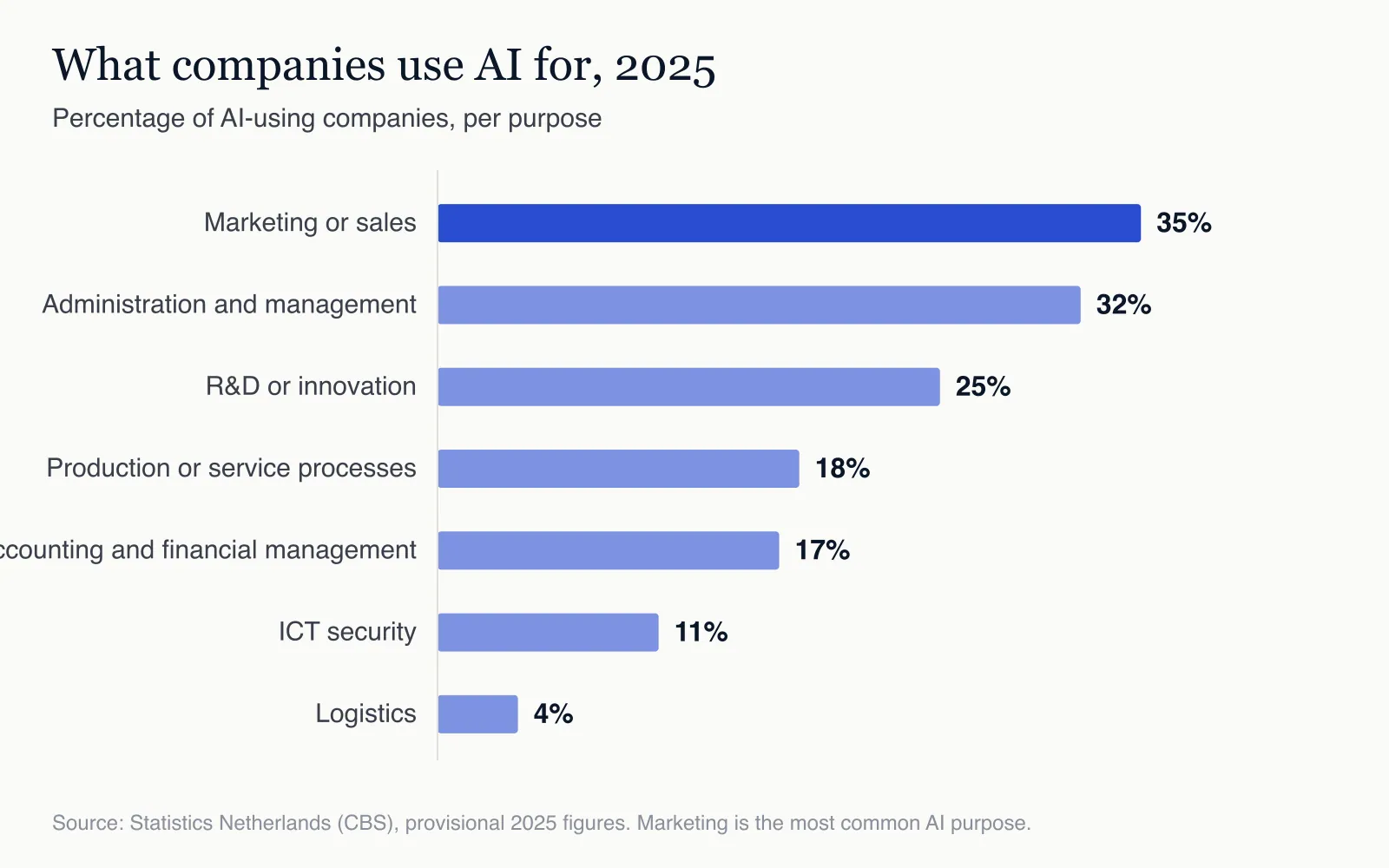
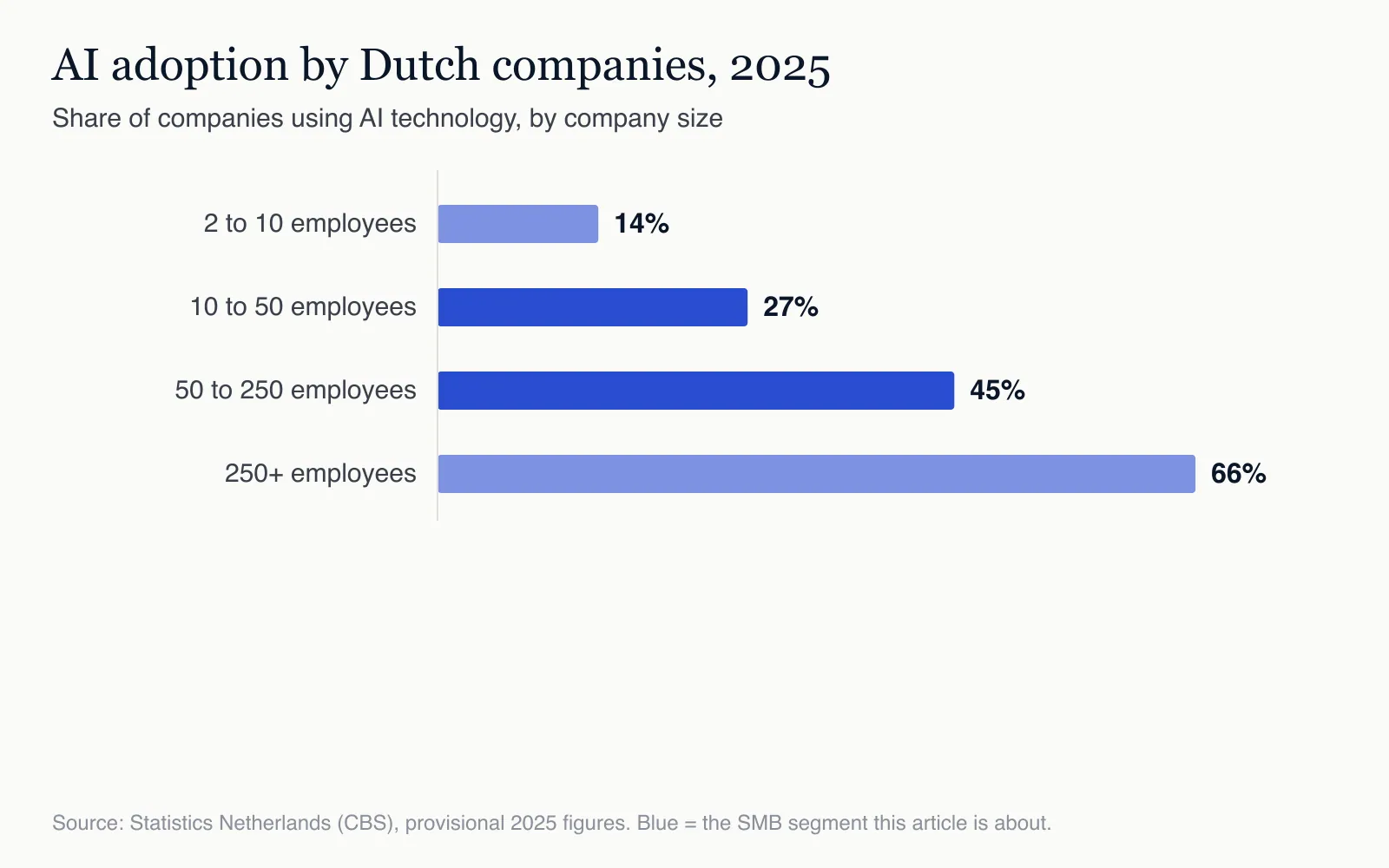
Marketing is where Dutch companies deploy AI most often: 35% of companies using AI do so for marketing or sales, more than for any other purpose, according to CBS. And the group is growing fast: of companies with 10 to 50 employees, 27% worked with AI in 2025, and among those with 50 to 250 employees it was already 45%. Ask those same companies what it delivers and the answer is usually: "it saves time". Nothing more.
That gap between "we use AI" and "we make money with it" tells the whole story. Buying a tool is not the same as booking results. Switching on ChatGPT for copywriting is not a strategy. Midjourney for your socials is not a creative approach. AI amplifies what you already do. What you don't have, AI won't conjure out of thin air.
This article shows where AI actually delivers money for SMB marketing in the Netherlands in 2026, which mistakes cost you money, and how to set up an implementation you can measure.
Where AI is already making a difference in marketing
Before we get to mistakes and approach: these are the places where AI delivers proven returns for SMBs in 2026.
Content at scale
Blogs, product descriptions, social media posts, email newsletters: AI can write large volumes consistently in your brand voice. Not by replacing your editor, but by making that same editor a lot more productive (in comparable projects usually 2 to 3 times as fast on routine work). Tools: Claude (Anthropic), ChatGPT, Gemini. The standalone AI writing tools of a few years ago have largely been overtaken by these general models. What makes the difference is not a tool but a set of prompts with your brand voice and a review pass before anything goes live. Without that, you get mediocrity at volume.
Image and video
Product photos, banners, headers, social ads, short videos: AI image generation is production-ready in 2026. Tools: Midjourney, Leonardo.AI, Recraft (Dutch-language), HeyGen for avatar video, Luma. For most B2B work you no longer need a photo studio. For luxury or genuinely human content, photography stays more valuable, and you won't catch up on that any time soon.
Personalisation and segmentation
Emails that adapt to recipient behaviour, dynamic landing pages, product recommendations based on browsing. Strong tools: HubSpot AI, Mautic with OpenAI extensions, Klaviyo predictive analytics. Return is measurable through click-through rate, conversion, and customer value. Condition: this only works if your database is big enough. Under a few thousand contacts, you'll get little out of it.
Data analysis and attribution
Dissecting GA4, finding conversion patterns, testing attribution models: AI does in minutes what a data analyst does in a day. Tools: ChatGPT Advanced Data Analysis, Claude with code execution, Looker Studio with AI extensions. Especially useful if you split budgets across channels and finally want to know where the levers sit instead of relying on gut feel.
Market research and competitor analysis
What are competitors doing on LinkedIn? Which topics score in your industry? Tools: Perplexity and the deep research features of ChatGPT and Gemini for current web research with source references. A weekly update that used to take 4 hours now takes AI 30 minutes. The real work is still someone drawing a conclusion from it.
AI amplifies what you already do. What you don't have, AI won't conjure out of thin air.
The three biggest mistakes
1. Generating content without a strategy
AI writes a blog post in seconds. Without a plan, without audience knowledge, without brand identity, that post is worthless. All AI content born this way looks the same, doesn't rank in search engines, and flattens your brand voice.
Most SMBs throw themselves at AI content without thinking about why and for whom. The result is a blog full of mediocre pieces nobody reads, and that isn't a marketing mistake, that's a budget mistake. First pin down your audience and topic clusters. Only then bring in AI to finish routine pieces faster.
2. Collecting tools without measurable goals
"We have ChatGPT, Midjourney, Jasper, and HubSpot AI." Fine. But what does it produce? How many hours does it save your team per week? How many more leads per channel? How much higher is your conversion?
No measurable goals before you bring in tools means you'll never know if it works. Your AI budget becomes a creeping cost instead of an investment. Set one concrete goal per tool: 30% lower production cost for content, campaigns live twice as fast, 15% higher email click-through rate. One number per tool. Not five.
3. Underestimating implementation
Getting AI into your marketing processes takes time. Count on at least 6 months for something that really stands up. That's not a consultant story, it's simply the time needed to work out prompts, train your team, rebuild processes, and discover what does and doesn't work in your situation.
Companies that want to "implement" AI in 4 weeks end up with an expensive collection of tools nobody uses well. Companies that take the time end up with a marketing team that structurally does more with the same people. Patience is literally worth money here.
What does work: a phased approach
Month 1-2: data and understanding Don't start with tools, start with understanding. Which campaigns worked? What were the goals? Where's your biggest pain on content and pulling in leads? Train your team in prompt technique and the basics of AI. No marketing buzzwords, just how you steer these tools effectively. This is the phase everyone wants to skip and where most projects fall apart.
Month 3-4: one pilot, not five Pick one process. For example content for social media or personal emails. There you push AI all the way through: tools, prompts, workflow, training, goals. Measure everything: time saved, quality, conversion. The goal is not a big rollout, but one example that demonstrably works for your business. With that example in hand you can sell something to the board. Without it, everything stays a feeling.
Month 5-6: optimise and prune Refine on data. Which prompts work? Which output quality do you accept? Which checks must stay manual? Scale what works, stop what doesn't. Many teams discover here that they bought tools they didn't need. Stopping is fine. Not failure, just learning.
Month 7+: scale up Roll successful pilots out to other processes. Build AI in as a step in your workflow, not as a separate tool next to the rest. Revisit your marketing goals: old benchmarks no longer hold once a process runs with AI.
Concrete examples from Dutch SMBs
Web shop, 200 SKUs. Product descriptions with Claude in the right brand voice. For 50 new products that costs 2 hours instead of 2 days. Per month, 15 hours times a copywriter's hourly rate is thousands of euros a year. Not an abstract story, just fewer hours on the invoice.
B2B service provider. Weekly LinkedIn posts. On Monday, AI makes a week's worth of posts based on industry news and their own client stories. The marketer reviews and publishes. Result: 4x more posts in the same time, more reach as an authority, better leads. The marketer isn't replaced, they now work one layer up.
Web shop with a busy customer service team. AI chatbot for the most common questions: delivery times, returns policy, product info. A well-built chatbot with a knowledge base typically handles 60 to 80% of questions on its own, the customer service team focuses on the tricky rest. Customer satisfaction rises because response times drop to seconds. Condition: a solid knowledge base and a clean handover to a human.
What 2026 added: agents and AI search
Two shifts have changed this story since the first AI wave. First: the work is moving from tools to agents. A tool waits for your prompt; an agent runs a task independently, from assembling a weekly content plan to enriching incoming leads. For marketing, that means the time savings no longer come per task, but per process. What such an agent costs and when it pays off is covered in the AI agent cost overview.
Second: your customers now search with AI too. Someone looking for a supplier increasingly puts that question to ChatGPT or Perplexity instead of Google, and gets a short list of names as the answer. That changes where your marketing effort should go: being cited by AI is not the same as being found, and you measure it differently than traffic. Add that question to your measurement plan above: am I named when someone puts my buying question to an AI?
Data and compliance: don't underestimate this
Working with AI in marketing means working with customer data. GDPR is non-negotiable, and the EU AI Act is coming with additional obligations for higher-risk applications. This isn't future music, this is legislation.
Three minimum checks before you start. One: process customer data only in tools that meet GDPR, no consumer ChatGPT with customer data in it. Two: put a data processing agreement in place with every AI vendor that touches personal data. Three: be transparent in your privacy statement about which AI you deploy and for what.
For SMBs this doesn't have to be a giant project. But the start-without-checking risk is real. GDPR fines have already been handed out for careless AI implementations, and marketing is usually the first place things go wrong.
How long before AI marketing pays for itself?
The honest calculation: AI marketing is profitable the moment the saved hours and extra conversions exceed the tool and implementation costs, and you can work that moment out yourself instead of hoping for it. Take the webshop example above: 15 saved hours per month times a copywriter's hourly rate, against a few tens of euros in tool costs and the one-off time to set up prompts and workflow. That ratio turns positive within a few months.
What determines the timeline isn't the tool but the embedding: count on at least 6 months before an AI workflow truly stands, with the first measurable savings already during the pilot phase in months 3 and 4. Skip the understanding phase to go faster and you pay it back in tools nobody uses. Doing the maths upfront (one goal per tool, one number) is exactly what separates an investment from a creeping cost.
The core
The difference isn't in which AI tools you use. It's in how sharply you deploy them. The marketers leading in 2026 aren't the ones with the most tools, they're the ones with the sharpest prompts, clear goals, and a structured implementation process.
Start small. Measure everything. Scale what works. Stop what doesn't. And take the time you need to do it right, instead of racing to tell a board you're "doing something with AI".
Curious where the biggest AI opportunities sit for your marketing? Take the free AI Scan and get a personal analysis in your inbox within a minute.
Curious what AI can do for your business?
Take the free AI Scan and find out in 1 minute.
Frequently asked questions
- How long until AI marketing becomes profitable?
- Profitable is the moment saved hours and extra conversions exceed tool and implementation costs, and you can calculate that upfront. A webshop saving 15 hours of copywriting per month turns positive within a few months. For an AI workflow that truly stands, count on at least 6 months, with the first measurable savings already in the pilot phase (months 3 and 4).
- Does AI marketing actually deliver ROI?
- Yes, but only if you deploy and measure it sharply. Buying a tool is not a strategy: AI amplifies what you already do, it does not conjure a brand or plan out of nothing. The gains come from content at scale, image generation, personalization and data analysis, provided there is a prompt library with your brand voice, clear KPIs and a review process behind them.
- Which AI tools work for marketing?
- Content: Claude, ChatGPT, Jasper. Image and video: Midjourney, Leonardo.AI, Recraft, HeyGen. Personalization: HubSpot AI, Klaviyo predictive. Data analysis: ChatGPT Advanced Data Analysis, Claude with code execution. Market research: Perplexity Pro, Brand24. But the difference is not in the tool, it is in sharp prompts and clear goals.
- What are the biggest mistakes with AI in marketing?
- Three. Generating content without a strategy (flat pieces nobody reads and that do not rank). Collecting tools without measurable goals (you never know if it works). And underestimating the implementation (count on at least 6 months for something that really stands, not 4 weeks).
- How do you measure the return on AI in marketing?
- One concrete goal per tool, not five: for example 30 percent lower content production costs, a 2x faster campaign launch or a 15 percent higher email CTR. Start with insight into what worked before, run one pilot in which you measure everything and update your benchmarks as soon as a process runs with AI, because the old ones are no longer relevant then.