
More and more people no longer put their buying question to Google, but to ChatGPT or Perplexity. Not "AI agency Zeeland" in a search bar, but "which company can build an AI agent that reads my invoices?" in a conversation. The answer they get is a short list of names. If you are not on it, you do not exist for that buyer.
I was curious how that mechanism actually works, so for a stretch of time I tracked which sources AI search engines cite when they answer this kind of question in the Dutch AI market. What came out was not what I expected, and it is useful for any business that wants to be found online, not just AI agencies.
What AI actually cites, and what it does not
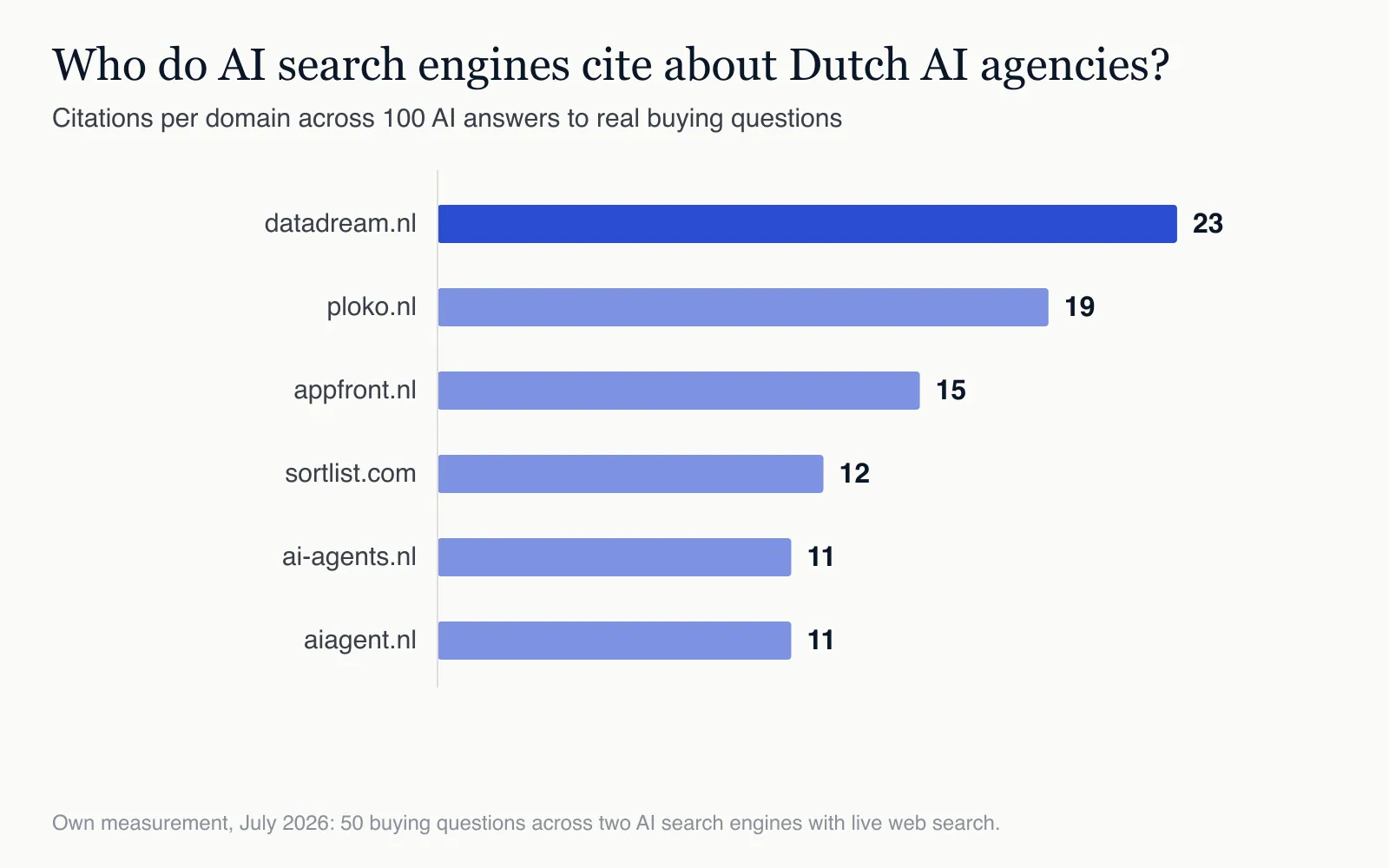
The first surprise: AI search engines almost never cite a homepage or a service page. They pull their answers from a handful of fixed formats. In the market I followed, the vast majority of citations went to four kinds of pages: overview guides ("how to choose a partner for X"), rankings ("the best providers of Y"), how-to articles and comparisons. Together they accounted for the lion's share of everything cited.
So your most polished service page barely shows up in those answers. Not because it is bad, but because it is not the format an AI reaches for when someone asks "who can do this for me?". For that question the model picks a list, and that list is almost always on a site other than yours.
Being cited does not bring you visitors
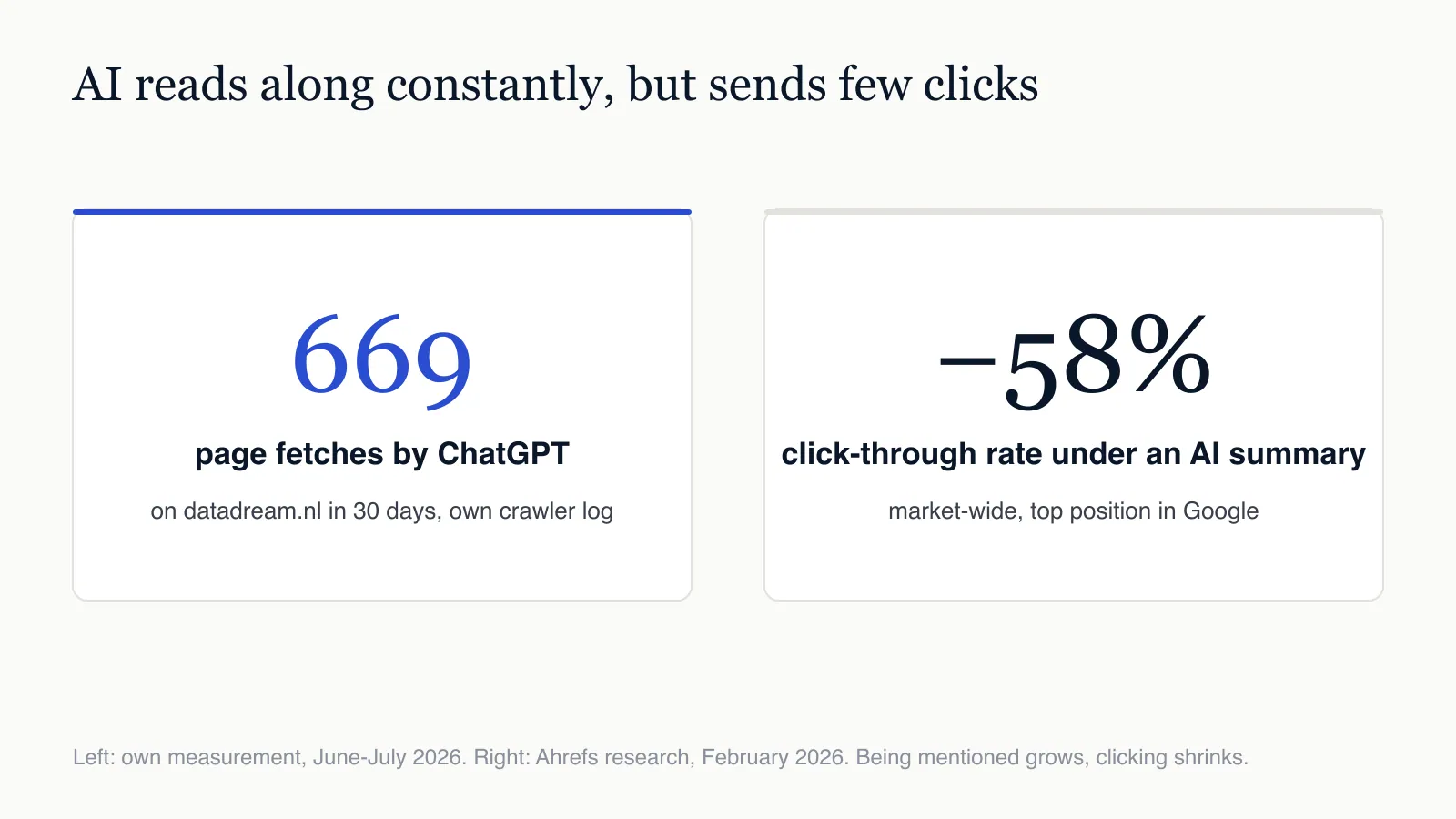
The second surprise was less comfortable. Being mentioned and getting visits are two different things. During my measurement window I saw the gap up close: ChatGPT fetched the site hundreds of times a month to build answers, while click-through rates from AI answers are collapsing market-wide. Whoever steers on clicks is watching a meter that registers less and less.
That makes more sense than it seems. An AI answer is the end point in itself. The user reads the summary, sees three names, and maybe remembers one. Click-throughs do exist, but they are scarce and unevenly distributed: Pew Research measured that users click a result only half as often when an AI summary is present, and referral traffic from ChatGPT is growing fast but stays below one percent of total traffic for most sites, concentrated on big names like Reddit and Wikipedia. For most business sites it is still a rounding difference. Your visibility does not sit in clicks, then, but in whether your name appears in that answer and in what context. That makes the old reflex ("chase more traffic") less important than a new question: am I being mentioned, and is what is being said about me correct?
Why a perfect site of your own is not enough
This is where the two findings meet. If AI answers "which company for X" questions from other people's lists, then whether you appear in the answer is not decided by your site, but by whether other, trusted sources mention you. In the measurement I saw that pattern again and again: companies with a technically perfect site and complete content that are still missing from the answers to concrete buying questions. The reason is not on the site, it is next to it: they are not on the lists the model draws from.
That is not a pleasant message, because your own site is in your hands and someone else's is not. But it is the honest one: at a certain point, more polishing of your own pages is a waste of your time, and the gains shift to the outside.
What to do about it in practice
A few things that do work, in order of how much they return.
Make sure AI is actually allowed to read you. Sounds obvious, but plenty of sites unknowingly block the crawlers from OpenAI, Anthropic or Perplexity. Check your robots settings and explicitly allow those bots. This is free and takes five minutes.
Tell the model who you are, in structured form. With schema markup (organisation, services, frequently asked questions) you give an AI hard facts instead of leaving it to guess. That lowers the chance of nonsense being told about you, and raises the chance that you are classified correctly.
Publish in the formats AI cites. An honest buyer's guide or comparison in your field has more chance of being cited than the tenth service page. One caveat: if you crown yourself the winner of such a list, a model weighs that lightly. It has to be genuinely useful to the reader, otherwise it backfires.
Build presence in places AI trusts. This is the real work and it takes time. Being mentioned in trade media, in neutral overviews, in a guest article: those are the sources models cite from. One mention in an authoritative place does more for your AI visibility than a month of tweaking your own copy.
Measure whether you are being mentioned. You do not need an expensive tool for this. Each month, put a few real buying questions from your market to ChatGPT and Perplexity, and note whether your name comes up and what is being said about you. That is your new position check.
Staying level headed
AI search engines are changing how people find companies, but the underlying logic is not new. Whoever appears in the answers is whoever gets mentioned by others in the places the model looks. Having your own house in order is the baseline, not the winning point. The gain sits in other, credible sources mentioning you, and you earn that over the longer term, not with the flip of a switch.
For most businesses that is more reassuring than discouraging. It means you do not have to write a new page every week. It means your energy is better spent outward: on the kind of presence a model reads as trustworthy. Less polishing, more being seen where it counts.
Curious what AI can do for your business?
Take the free AI Scan and find out in 1 minute.
Frequently asked questions
- Will AI search engines find me if my website is good?
- A good website is the baseline, but not enough. AI search engines usually answer 'which company for X' questions from lists and guides on other sites. Whether you appear in that answer depends mostly on whether trusted sources mention you, not on how polished your own page is.
- Does being cited by ChatGPT bring visitors?
- Often barely. An AI answer is the endpoint itself: people read the summary and rarely click through. Your visibility is therefore about whether you're named and whether it's accurate, not about clicks. Measure it by asking real buying questions to ChatGPT and Perplexity each month.
- What can I do to be more findable in AI search?
- Allow AI crawlers in your robots settings, give the model hard facts via schema markup, publish in the formats AI cites (guides, comparisons), and build mentions in trade media and neutral roundups. That last one delivers most and takes the most time.