
I built an analytics dashboard for a client in the leisure industry. During the handoff video call, I gave him a short walkthrough plus a guide for tweaking the dashboard himself with Codex. No consulting hour booked for later, no ticket system for small changes. Two days later I got an email: he had added the goals and the key data insights on his own, without needing me again.
That same dashboard is still running in production and does exactly what he wants. For small tweaks, I'm out of the loop. That means less revenue for me in the long run. And it's a better outcome for both of us.
Why I do this on purpose
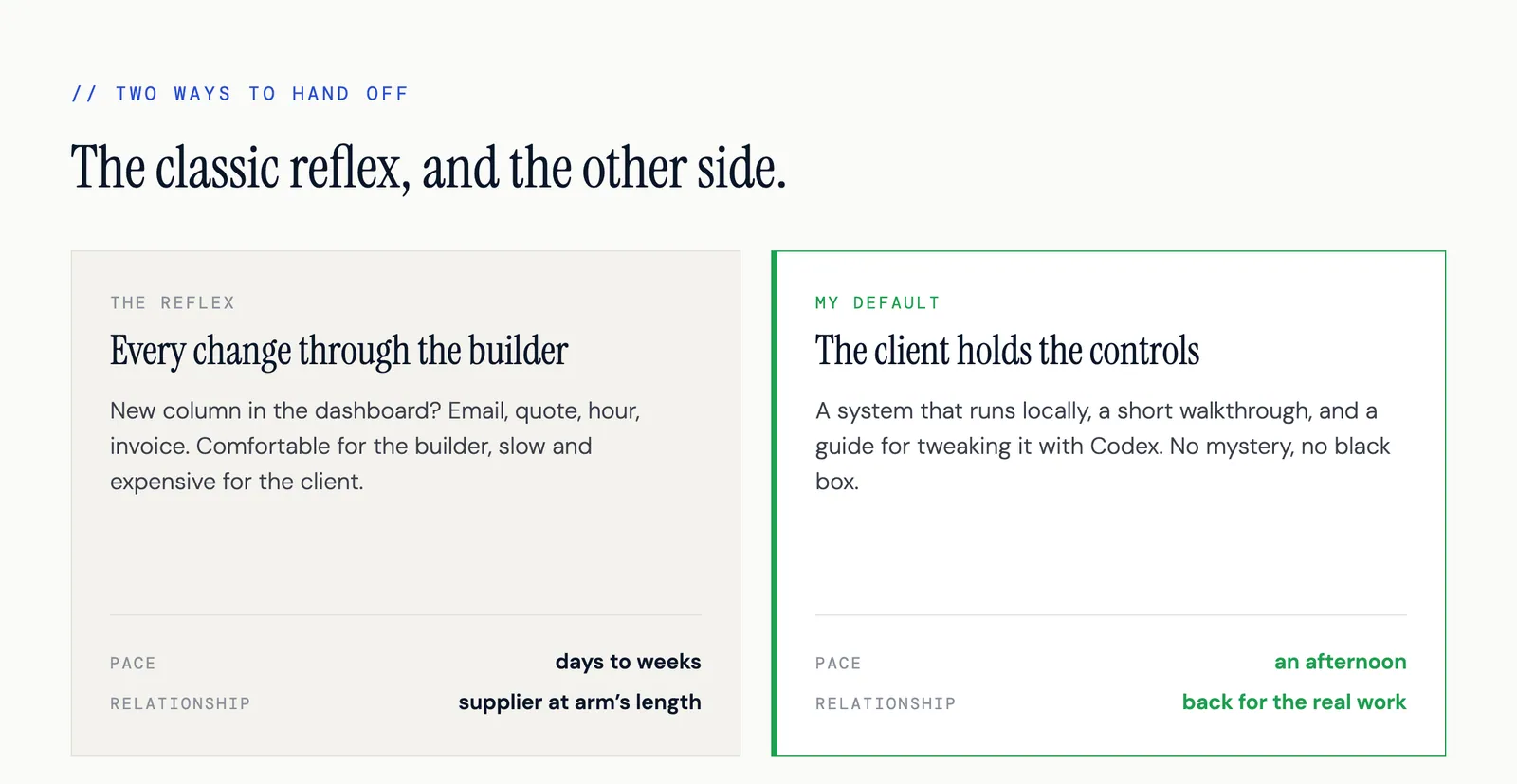
The classic reflex at handoff is different. You build something, put a thin layer of explanation on top, and make sure every change runs through you. New column in the dashboard? Email, quote, hour, invoice. Small text change? Same route. For the builder it's comfortable: you get a recurring trickle of work without having to sell anything new. For the client it's slow and expensive for something he'd actually want to do himself.
I deliberately choose the other side. If a client wants to make his own tweaks, I give him the tools for it. Concretely in this case: a dashboard that runs locally, a short explanation of the structure, and a guide for using Codex to add a goal or change a chart himself. No mystery, no black box.
What the client did with it
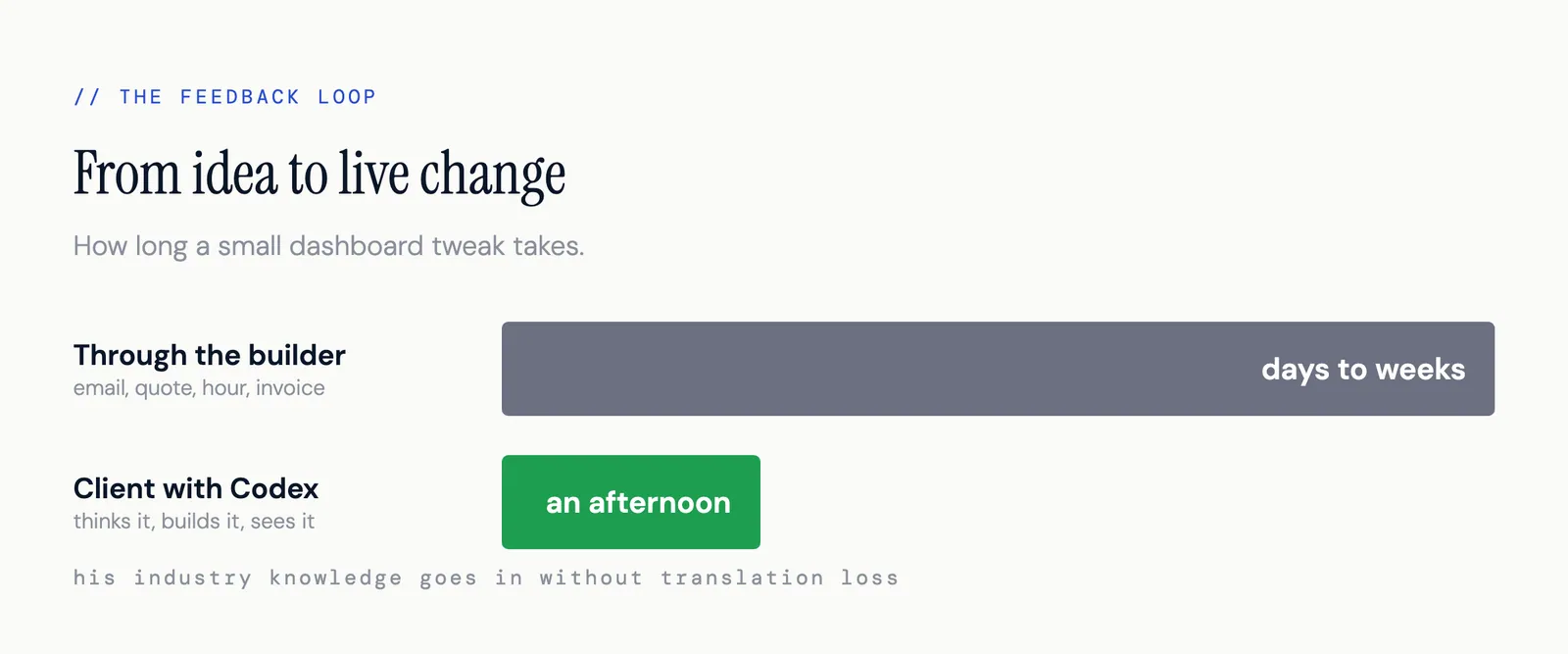
Within two days he had added the goals he found most relevant, plus a handful of insights I didn't know at handoff that he wanted to see. That last part is the whole point. He knows his industry better than I do. He knows which numbers matter on a Monday morning, which seasonal patterns he wants sharp, which outliers are a signal and which are noise. If he has to route that knowledge through me, something gets lost in translation that you can't get back.
By handing him the controls, nothing gets lost. He thinks something, he builds something, he sees whether it holds up. The feedback loop that used to take days or weeks now takes an afternoon.
What it costs me
Honestly: this costs me money. Every small change he makes himself is a change I don't invoice. If I'd played it cynically, I could have sold him a support contract with a punch card for changes. He probably would have signed it. At handoff, trust is at its peak and resistance to an extra line on the quote is at its lowest.
I don't do that, and not out of naivety. I don't do it because the math works out differently over a longer horizon.
Why the math works
A client who can work with his own system independently comes back sooner for the next, bigger job. Not for an extra column, but for a whole new piece of automation, an agent that takes something over, an integration he isn't going to build himself. Those are the projects where the value sits, for him and for me.
On top of that, it does something to the relationship. The moment you deliberately put a client in a position where he no longer needs you for small things, the dynamic shifts. You're no longer a supplier he keeps at arm's length to control costs. You're someone who only comes back when there's something genuinely new to build. That's a nicer starting position.
And there's a third reason, maybe the most important one. If the client can steer himself, the system stays alive. Dashboards only the builder is allowed to touch turn to stone. Six months in, the goals from handoff are still there, while the questions the entrepreneur has now sit somewhere else entirely. Whoever can tweak it themselves keeps the instrument sharp.
When this works and when it doesn't
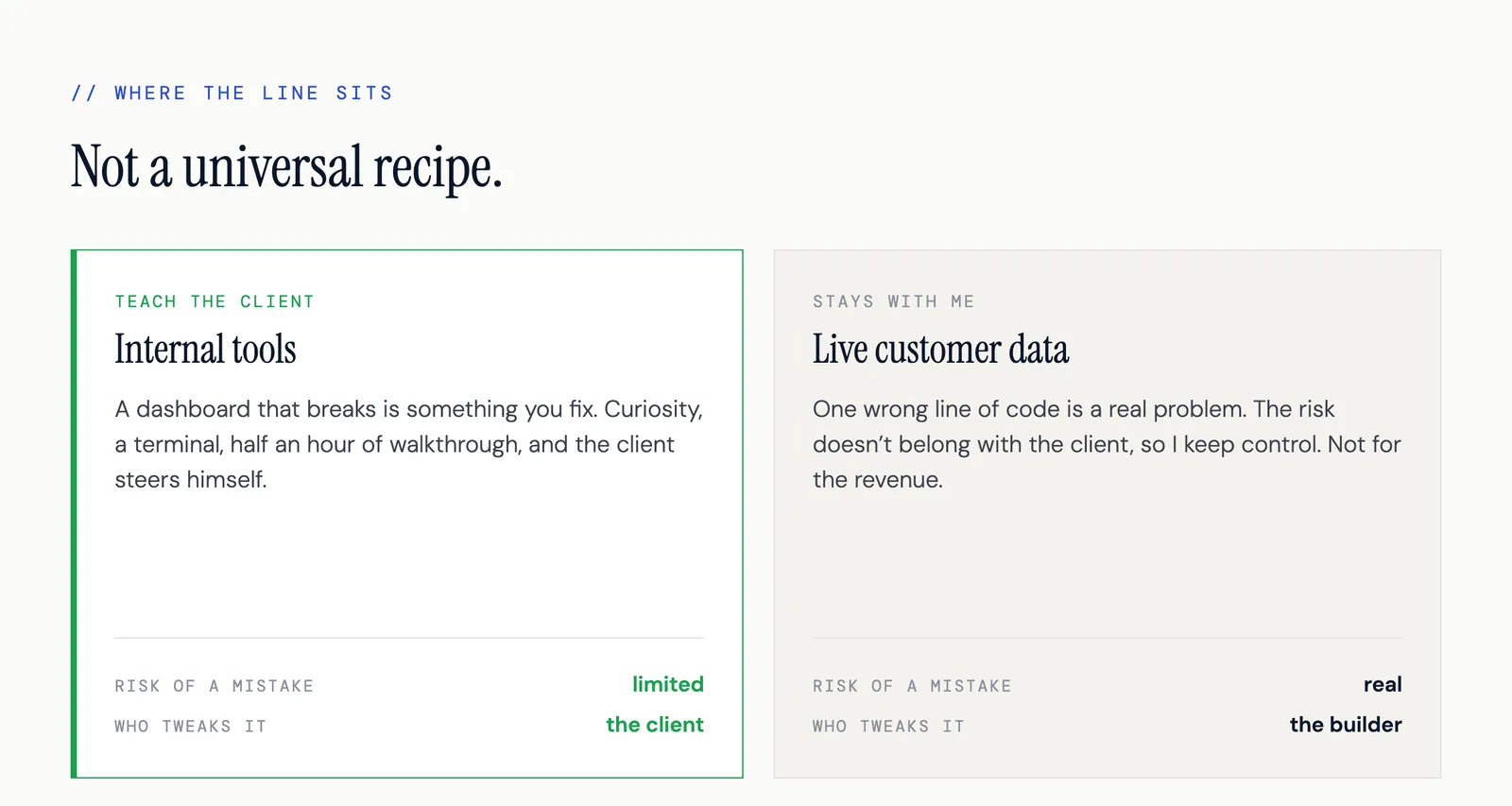
This isn't a universal recipe. It works when the client is curious, isn't scared of a terminal, and is willing to take half an hour of explanation seriously. It works with tools where the consequences of a mistake are limited: an internal dashboard that breaks is something you fix. It works less well with systems that handle live customer data, where one wrong line of code is a real problem.
For that second category I keep control. Not because I want the revenue, but because the risk doesn't belong with the client. The distinction is simple: if he can do it himself without anything bad happening, I teach him. If he can't, it stays with me.
The ground rule
When the client can do it themselves, both sides win. Even when it costs me revenue in the short term. I'd rather build something the client can carry on with without me than something he's stuck to. The first version delivers a dashboard that keeps running for years and a relationship the next project grows out of naturally. The second delivers a stream of small invoices and a client who wakes up one day wondering why he doesn't just ask someone else.
I know which of the two I want to be.
Curious what AI can do for your business?
Take the free AI Scan and find out in 1 minute.
Frequently asked questions
- What do I get at handover so I can make changes myself?
- A working system that runs locally, a short walkthrough of the structure, and a guide for using Codex to adjust things like goals or charts yourself. No black box, no forced middleman.
- Do I need to code to make changes myself?
- No, but you do need curiosity, comfort with a terminal, and willingness to take a short walkthrough seriously. With Codex you can add a goal or tweak a chart without being a developer.
- Why would a builder do this if it costs revenue?
- Short term it does cost small invoices. Long term it brings clients back for bigger work like new automation, agents, or integrations, and a relationship where that follow-on happens naturally.
- Does this approach also work for systems with customer data?
- Less well. For systems with live customer data where one wrong line of code is a real problem, I keep control. For internal tools like a dashboard where a mistake is easy to recover from, I teach the client to do it themselves.
- What happens to the dashboard after six months?
- When the client can adjust it themselves, the tool stays sharp and follows their current questions. Dashboards only the builder is allowed to touch calcify: the original goals stay while the real questions have moved on.
- What kind of follow-up work does bring me back?
- Not for an extra column or copy tweak, but for a whole new piece of automation, an agent that takes something over, or an integration you won't build yourself. That's where the real value sits.