
Most AI decisions in a business don't need a text. They need a yes or a no.
Should this email go to customer service or to accounts? Is this signup real, or a bot? Is this lead worth following up? Today you often ask a large language model like ChatGPT or Claude, which then writes a whole paragraph to end up saying "accounts". That works, but it is slow and expensive when you do it a thousand times a day.
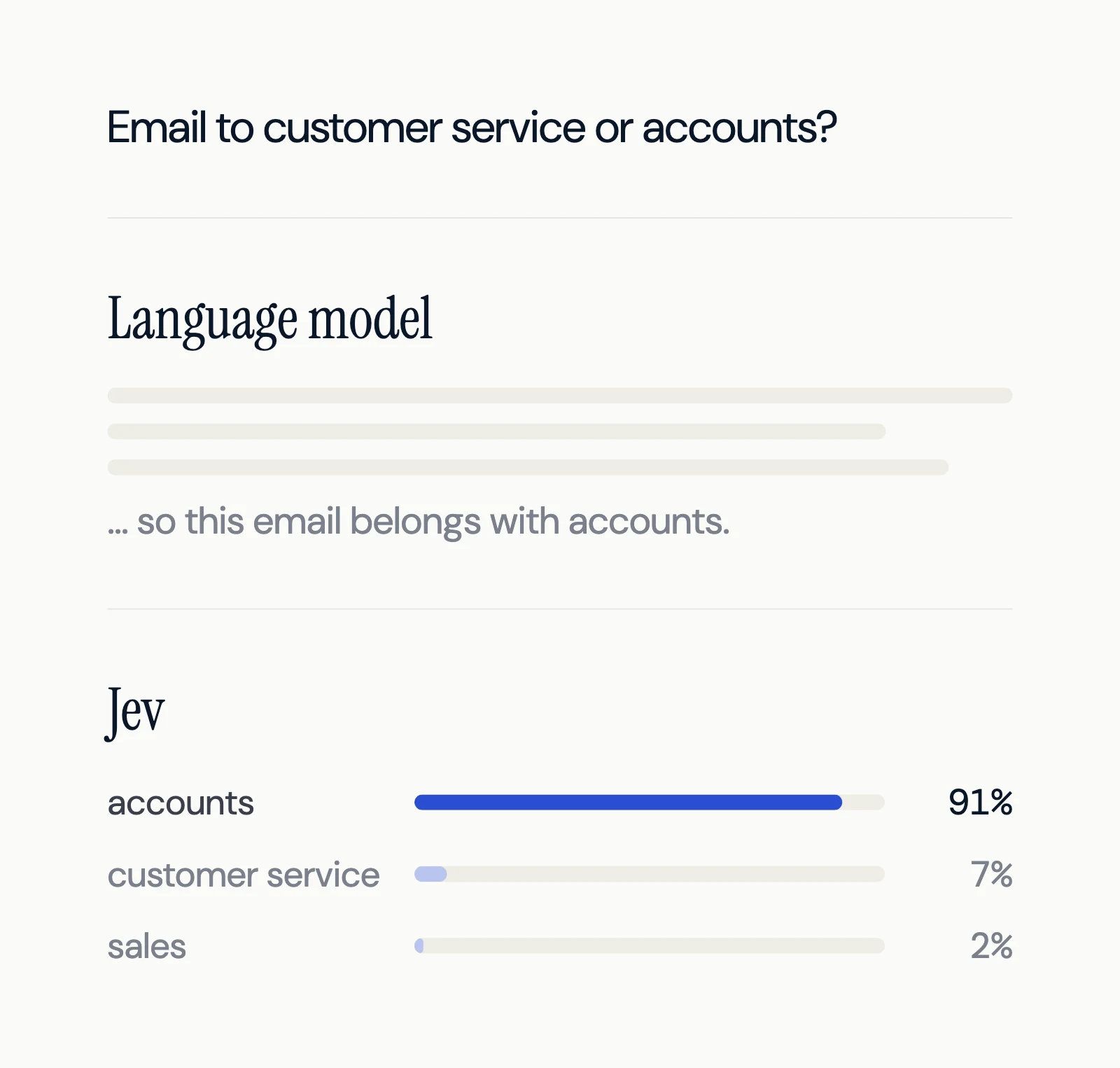
On 15 September TypeSafe AI released a model that does exactly that other part of the work: Jev. I have spent the past weeks with it: I read the documentation, built with it and looked at what developers do with it in their own projects. This is what I learned.
A model that doesn't talk
Jev doesn't write text. You give it a piece of text or data, together with a question whose possible answers are fixed in advance. What you get back is how likely each answer is. There are three kinds of questions: pick one option from a list, place something on a scale you describe yourself, or say how likely it is that something is true.
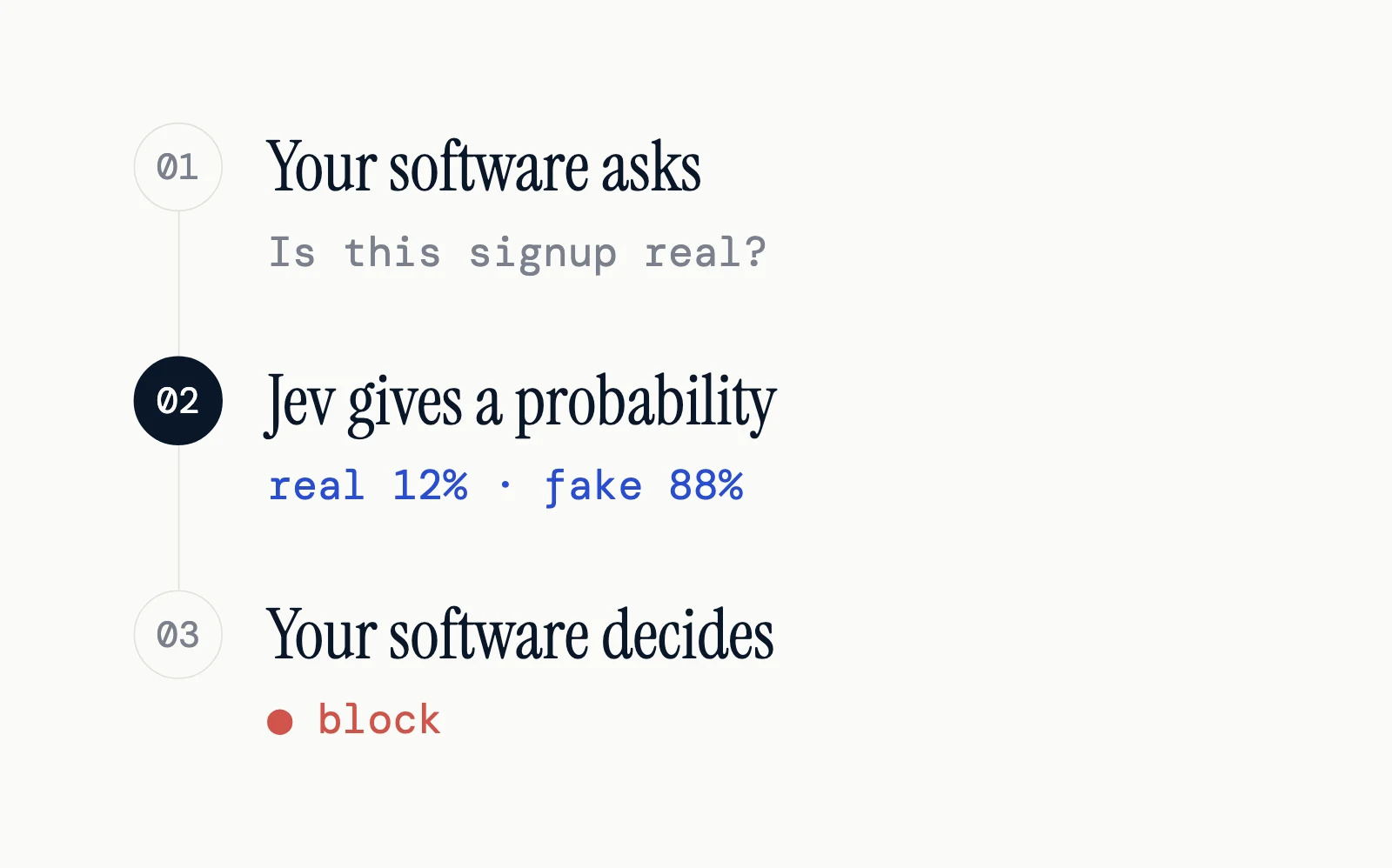
Because Jev doesn't have to come up with sentences, it is fast and cheap. A question is usually answered within a tenth to half a second. You pay 4.2 dollar cents per million tokens you send in, and the answers themselves are free. In its documentation the company calls it a model to build software with, not an agent: it never chooses the next step itself.
A smart rule in your software
The best explanation I came across: think of Jev as an if-then rule in your software, except one that understands text. You call it at the point where your code needs a judgment, and your code then does something with the answer. One developer showed this by sorting more than 32,000 messages from his own AI chats, with a slider to set the threshold: how sure Jev has to be before a message goes into a bucket.
A useful rule of thumb goes with it. If a person needs more than ten seconds or so to think about the decision, Jev is the wrong tool. It is made for the quick, almost automatic decisions you would make yourself without thinking, only a thousand times in a row.
Jev answers a question. Your software decides what happens next.
What developers are building with it now
In the week and a half after the launch, dozens of examples appeared. The most useful ones have one thing in common: Jev does the sorting, and the rest of the system stays as it was.
Sort first, then the expensive model. In a comparison with a thousand emails judged against seven rules, Jev did the job in 70 seconds for 9 dollar cents. One of the cheaper regular language models took five minutes and 62 dollar cents. The lesson: let Jev sort the pile, and only use a large language model on what is left, to write a reply or an analysis.
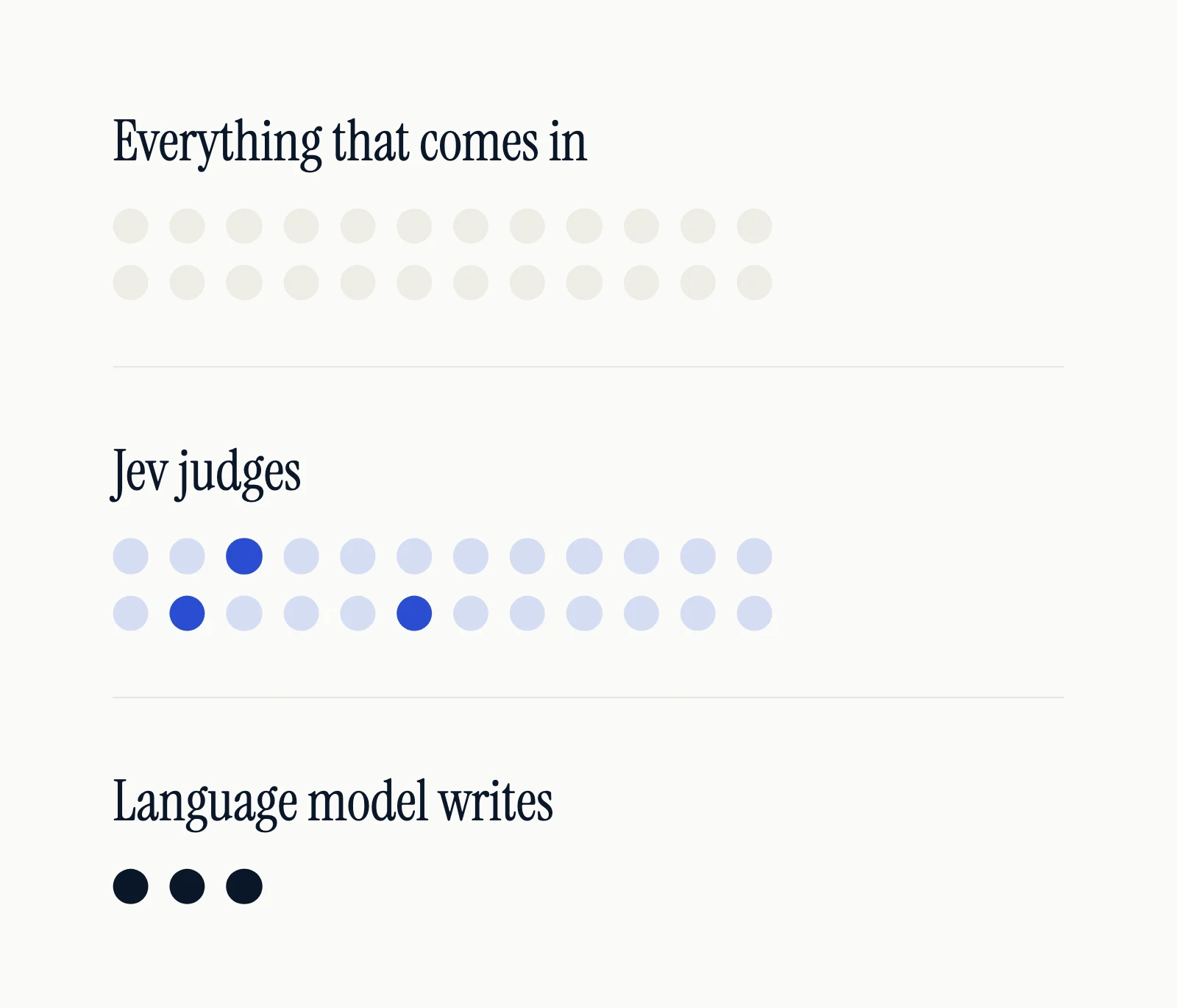
Scoring leads. Jev can score a list of 250 potential customers on two criteria in four seconds, for one cent. After that, a language model like Claude only has to continue with the promising ones, for example to research them or draft a first message.
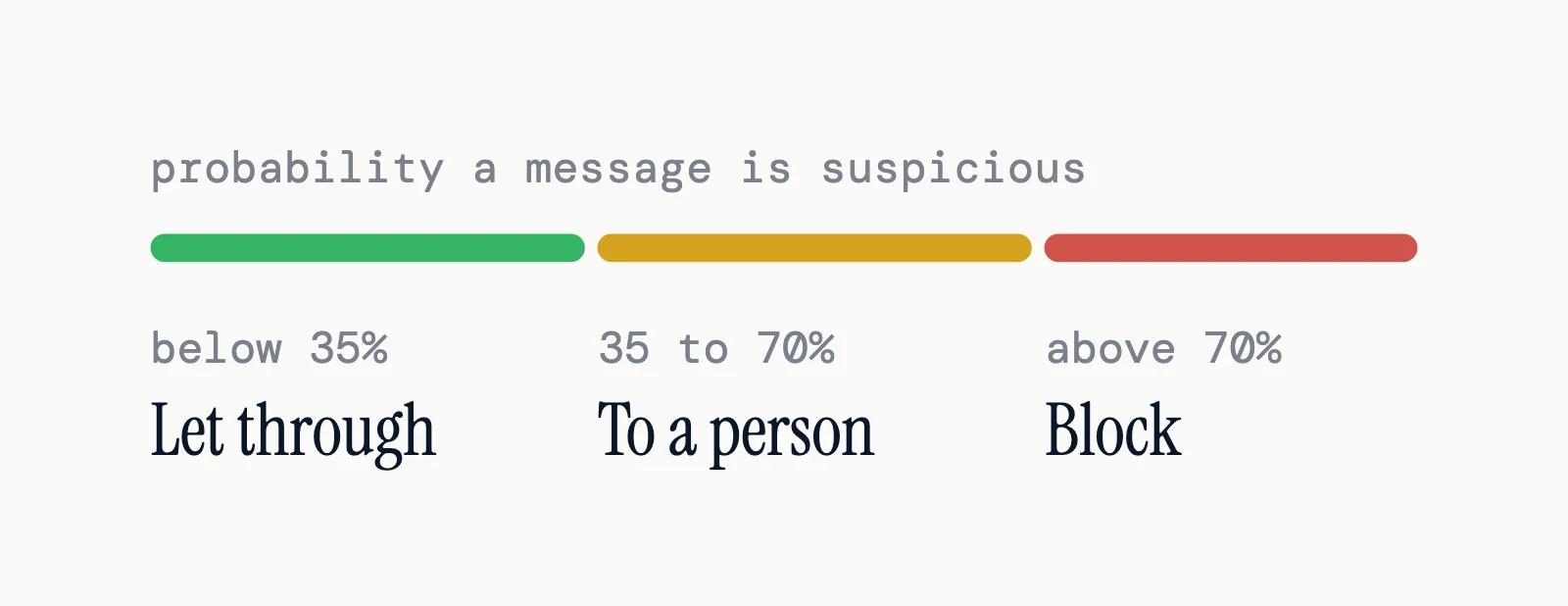
Stopping fake signups. One software team has Jev judge every new signup on its platform every fifteen to thirty minutes. Together with a service that checks the people signing up, that costs about a dollar a day. Above a certain confidence, an account is blocked automatically. The same idea works with three zones, for example against messages that try to trick an AI: block above 70 percent, send to a person between 35 and 70 percent, let it through below that.
A check before an AI agent acts. In one demo Jev sits between an AI agent and its actions. Before the agent does anything, Jev answers four questions: does this action match what was asked, is information missing, does the data come from the conversation, and is it too early? A few lines of ordinary code then decide whether the action goes ahead or the agent has to ask first.
The right model for each task. Jev can decide per task which model gets the work: the smallest for simple jobs, the largest for the real thinking. Jev itself costs almost nothing, and every task that doesn't go to the expensive model saves money.
Better answers from your own documents. A chatbot that looks up answers in your own documents is only as good as the passages it finds. If you let Jev judge those passages for relevance, with criteria you write down in plain language, the right passage ends up on top much more often. In that test it went from 21 to 54 percent of cases.
Where it doesn't fit
There are also plenty of examples of how not to do it. In a livestream a developer had Jev pick every move in a card game and couldn't get it to work: the game requires planning ahead, and Jev can't do that. Someone else had Jev choose every minute between buying, holding or selling bitcoin, and that went badly. Which makes sense, because the right answer isn't in the data. The pattern: as soon as Jev has to plan ahead, or the answer isn't in the data, it goes wrong. A single choice per step can work, as long as your own software stays in charge.
Beyond that, there are three things to watch. The figures of almost 200 times faster and over 400 times cheaper come from TypeSafe's own tests, and the company itself notes that this is the top end of what you get in practice. People who measure it themselves usually land somewhere between a few times and a little over ten times faster than the cheapest regular language models. Still a lot, but don't count on the headline numbers.
Jev also works best in English. It can handle other languages, but less well, so test it on your own texts first.
And Jev runs at an American company. TypeSafe promises it doesn't train on what you send, but how long your data is kept is not clearly defined. Only large enterprise customers can agree that nothing is stored. So don't send it names, customer data or sensitive information without looking into that first.
Four questions before you start
From everything I saw, four conditions come out. Jev only pays off when all four hold.
Do you do this hundreds of times? The gain is in volume. With five decisions a day you are faster yourself.
Is the answer in what you send? An expert should be able to decide in a few seconds based on what is there. If it depends on knowledge that only exists in your head, it goes wrong.
Does your software stay in charge? Jev answers the question, your own system decides what happens next.
Is a mistake cheap? Sorting, filtering and routing, with doubtful cases going to a person. Not for payments or final decisions.
If you want to start, pick one decision that comes up often and where it is clear afterwards what the right answer was. Write down fifty examples with the correct answer, make the question as concrete as you can, and above all look at how often Jev is right at the moments it says it is sure. That tells you more than any video.
The question worth asking yourself
Jev can do far less than ChatGPT or Claude. That is exactly why it fits in places where a large language model is too slow or too expensive, and where today a few rough rules or a person works through the pile.
So which decision do you, or your team, make a hundred times a day in the same way? That is the work a model like Jev can take over, while you spend your time on the decisions that really need thought.
Curious what AI can do for your business?
Take the free AI Scan and find out in 1 minute.